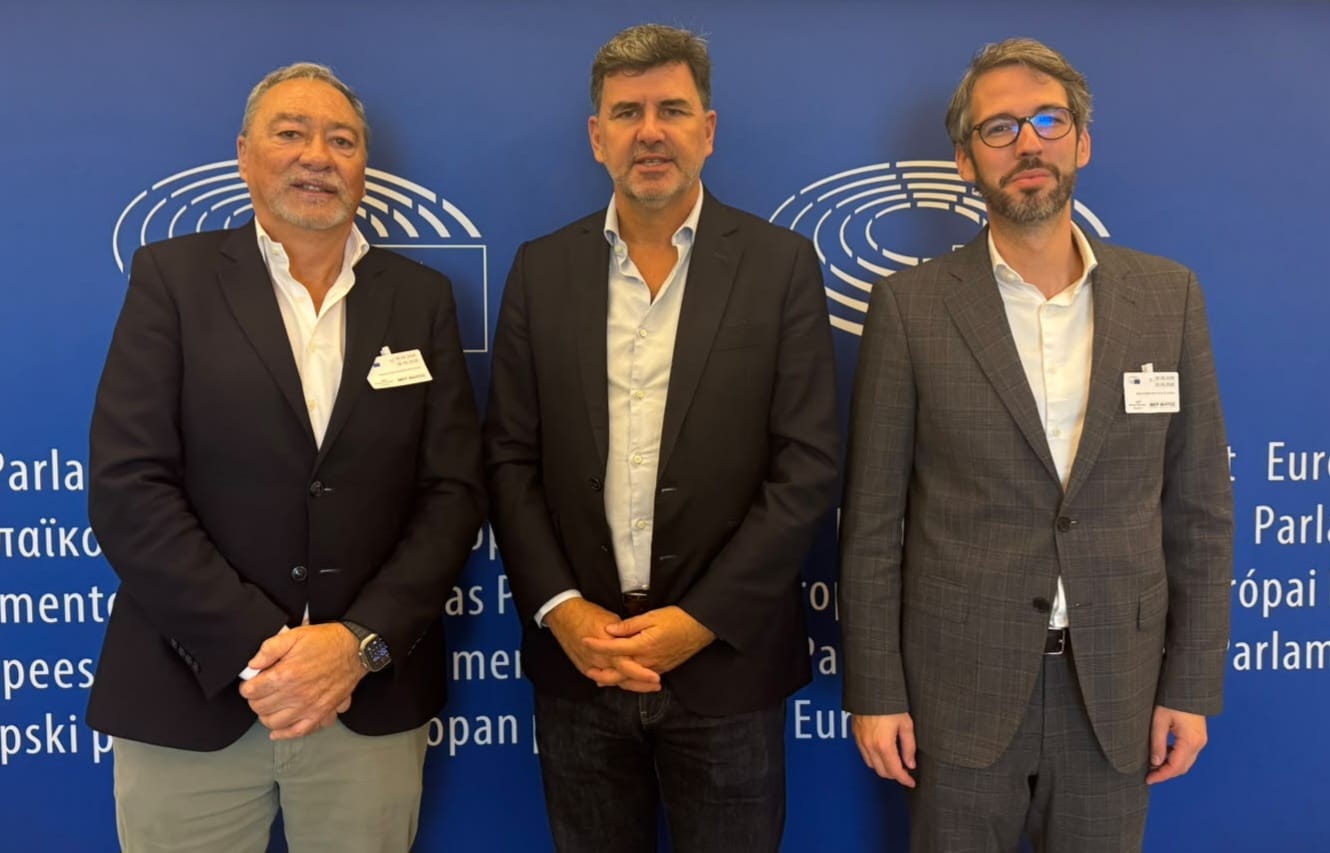
Nicolás González Casares, a PSOE Member of the European Parliament and a member of the S&D Group, calls for the expansion of data centres to be managed in a way that prevents the race for AI from deepening Europe’s energy and technological dependence.
By Nicolás González Casares
Published on democrata.es
15 September 2026
It is welcome that a public debate on the rollout of data centres has finally begun. In Spain, it was prompted by the government’s recent draft Royal Decree on the sustainability, efficiency and sovereignty of data centres. For that reason alone, the draft should be welcomed, even though the debate has been taking place for months, much less visibly, within the digital and energy sectors.
The resources these infrastructures require are substantial, particularly in terms of energy. Their rollout can therefore affect wholesale electricity prices, grid costs and the need to build new electricity infrastructure.
In the United States, a pioneer in the large-scale development of data centres, their consequences — both positive and negative — have long been part of public debate. Heated controversies and growing public opposition in some areas have prompted states and counties to start adopting restrictive measures. The most striking case is New York, where Governor Kathy Hochul introduced a one-year moratorium on new hyperscale data centres on 14 July, while a new regulatory framework is being developed to protect consumers, infrastructure and the environment.
In Europe, some countries had already begun taking action. Ireland is the clearest example: according to the Irish statistics office, data centres accounted for 23% of total national electricity consumption in 2025. Following a four-year moratorium on their construction, a new plan has been approved with stringent requirements for these facilities. Denmark is also pursuing a reform to prioritise access to increasingly scarce grid capacity, with data centres among the sectors that could be assigned a lower priority.
Outside Europe, countries as different as Australia, Singapore and Malaysia are also moving towards greater regulation. Australia proposes requiring data centres to provide new renewable generation, firm capacity and flexibility, while avoiding passing their costs on to other consumers. Singapore presented its Digital Infrastructure Bill on 8 September, introducing sustainability requirements for data centres, while Malaysia already makes new investments conditional on sufficient energy and water being available and demonstrated compliance with environmental criteria.
Along similar lines, in his article Europe’s difficult choices on AI, published on Friday 11 September, Mario Draghi argued that Europe needs to expand its own computing capacity substantially if it is to preserve its sovereignty. But that expansion cannot ignore constraints relating to energy, grids, land or efficiency.
From an energy perspective, therefore, the increase in electricity demand and connection requests driven by data centres may exceed existing capacity and needs to be managed. The first challenge is deciding who should receive a scarce grid connection. If, for example, a data centre secures the electricity capacity that a steelworks employing hundreds of people needs to electrify and modernise its production, the public will probably struggle to understand that decision.
This problem is already becoming visible in some places. On 11 September, ACER published its opinion on Portugal’s resource adequacy assessment. Portugal’s national analysis identifies risks to electricity supply adequacy from 2028 to 2035 associated, among other factors, with the projected sharp increase in demand from large consumers, particularly data centres. ACER notes that Portugal may be overestimating the shortfall because it underestimates potential new investments, batteries and demand response. But it confirms that the problem exists and requires planning. At the very least, this warning puts into perspective the overreaction of some developers to Spain’s draft Royal Decree, including threats to move their investments to Portugal of all places.
The second risk is deepening our energy dependence on third countries at a time of particular geopolitical complexity. If powering European data centres requires us to burn fossil gas that Europe does not possess and must import, we can hardly claim to be gaining sovereignty. On the contrary, we would be losing it.
That is why requiring new data centres to use genuine, additional renewable energy makes sense both environmentally and economically. The same is true of maintaining high European standards for energy efficiency, resource use, storage, flexibility and reuse — areas in which we also have major European companies. If not every project can be connected to the grid, we must prioritise the most sustainable projects and those that bring the greatest value to our economy and society.
But there is a second dimension to sovereignty, probably even more important. In a particularly thought-provoking article published in the Financial Times on 2 September, Mehran Gul makes an essential point: hosting servers in a country does not mean having sovereign artificial intelligence capabilities, because the physical dispersal of hardware does not, in itself, decentralise technological power.
Clearly, a data centre located in Europe and primarily devoted to running US models such as ChatGPT, Claude or Gemini does not necessarily strengthen our digital sovereignty. A recent Bruegel policy brief on Europe’s computing capacity gap reaches a similar, albeit nuanced, conclusion: Europe’s computing shortfall cannot be resolved simply by installing infrastructure; grid access, permits and effective tools to ensure sovereignty over the use of that capacity are also needed.
Indeed, the opposite may happen: our technological dependence could put our autonomy at risk. We have already had a very concrete warning this year. We need only look back to 12 June, when the US government imposed export controls preventing foreign nationals from accessing the new Claude Fable 5 and Mythos 5 models, whether or not they were in the United States. Unable to verify every user’s nationality in real time, Anthropic had to suspend access to both models temporarily.
The restrictions on Fable 5 were eventually lifted on 30 June, and the service became available worldwide again on 1 July. Yet this was a vivid demonstration that having physical infrastructure on European soil does not mean controlling the services running on it. Regulatory tools do exist to reduce this risk, however, and we must put them to use. The aim is not to prevent major international companies from establishing themselves in Europe, but to require guarantees that Europeans can access, on equal terms, the services that use our energy, our grids and our territory.
Another way to strengthen our sovereignty is to promote a genuine European space for data and cloud services, with data resident in Europe and under European control. Developers choosing this model should be given priority. We should also favour data centres that provide computing capacity to European models — such as Mistral — and to the public infrastructure we are building. The Commission already has 19 AI Factories and is promoting new AI Gigafactories to increase Europe’s training and inference capacity.
These are some of the conditions needed to ensure a sustainable and sovereign rollout of data centres in Europe. We are still failing to meet them today. The focus is on rapid deployment and measuring success in installed megawatts, rather than maximising computing capacity for each unit of power used. Burning imported gas at today’s prices, even behind the meter, can hardly be efficient, quite apart from being environmentally unsustainable. Nor can we speak of sovereignty if these developments do not give our European societies greater control over the technology they host.
It is not enough to tell citizens and their representatives that these facilities are essential and must be accepted without question to avoid losing a race whose finish line, all too often, we have not even defined. But that is another debate: the international governance of artificial intelligence. And it deserves an article of its own.